
Local search has changed more in the past 18 months than it did in the five years before that. AI is the reason.
Google's Gemini integration, AI-generated local packs, and conversational search queries have all shifted how businesses get found in Google Maps and local results. The businesses winning local search in 2026 are not always the ones with the most reviews or the longest list of citations. Quite often they are the ones that worked out what AI systems actually look for and adjusted accordingly.
At Webplanners, a trusted local SEO agency in Melbourne, this is what we are building for Australian businesses right now.
Most businesses still think of local SEO the way it worked in 2020. Build citations, collect reviews, fill out the profile. That approach still matters but it is no longer enough on its own. AI platforms now interpret local intent and recommend businesses rather than simply listing them. Google Business Profile completeness, schema accuracy, citation consistency, and review quality all feed into that recommendation process. Getting these right is what determines whether your business gets surfaced or skipped.
How AI Is Changing Local Search
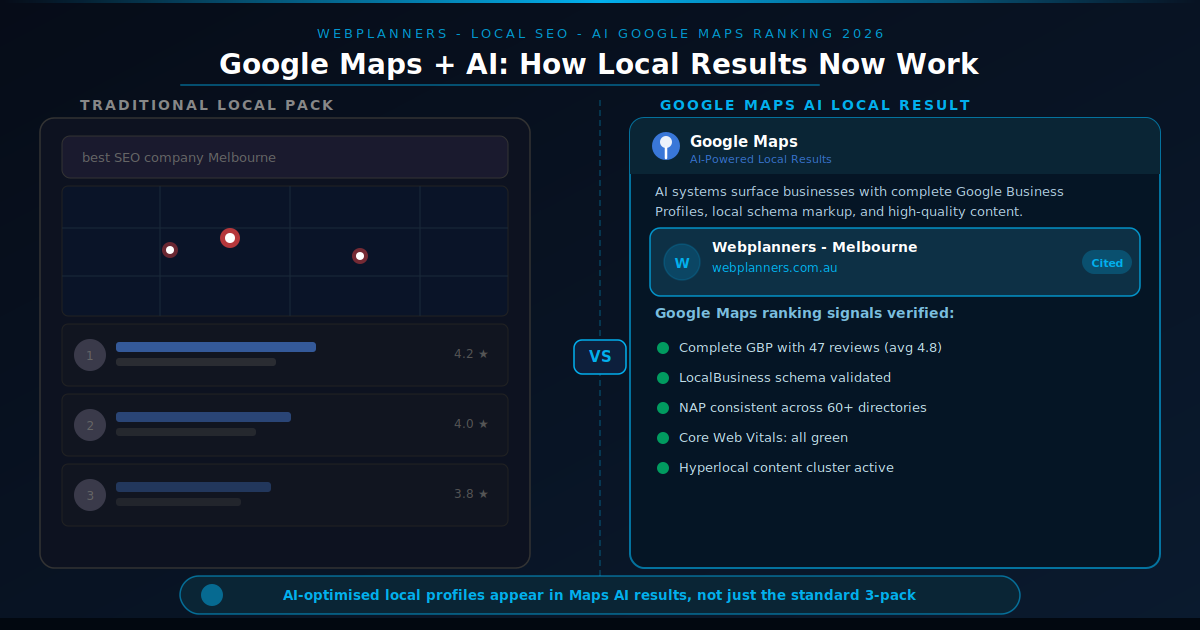
Local search used to be straightforward. Fill out your Google Business Profile, collect reviews, and build some local citations, and you're in the game.
AI has made the process more nuanced and, frankly, more interesting. Google's AI systems now analyse local queries with far more context than they did two years ago.
When someone searches for the best electrician in Brisbane or a Melbourne accountant for small businesses, AI interprets the intent behind the question, weighs the credibility of local businesses, and generates responses that go beyond a standard three-pack listing.
Businesses that structure their local data for AI readability are appearing more prominently, more consistently, and in formats that were not available in traditional local search.
What AI Local SEO Optimisation Actually Involves
1. Google Business Profile: Still the Foundation
Most businesses treat their Google Business Profile as a set and forget task. Fill in the name, add a phone number, upload a couple of photos, and move on. That was fine in 2021. It is not fine now.
Your GBP is the primary data source Google's local AI systems pull from when generating location-based answers. Gaps in that data don't just limit your traditional ranking. They give AI systems a reason to recommend someone else instead.
For AI Google Maps ranking in 2026, your GBP should include the following:
- Accurate business name, address, and phone number with no variations across platforms.
- A complete and regularly updated services list with individual service descriptions.
- A keyword-informed business description that clearly defines what you do and who you serve.
- High-quality, regularly added photos including interior, exterior, team, and service images.
- Consistent Q&A responses that reflect common customer questions.
- Active review management with genuine responses to every review, positive and negative.
Businesses with complete, well-structured profiles show up in AI-generated local results more often than those without. The profile is not a formality. It is the foundation everything else builds on.

2. Local Schema Markup: The AI Readability Layer
Local SEO AI optimisation requires schema markup that communicates your local data to AI systems without ambiguity.
LocalBusiness schema should include your full address, service area, opening hours, price range, accepted payment methods, and links to your social profiles. When this data is consistent with your GBP and your website content, AI systems have high confidence in your business information and are far more likely to surface you in AI search local ranking results.
As a leading AI SEO service provider, we implement and audit local schema as part of every local engagement because it is one of the fastest ways to improve your Google Maps visibility in AI-influenced results.
3. Hyperlocal Content Strategy
AI search rewards topical authority. For local businesses, that means creating content genuinely specific to your location and service area rather than repurposing generic content with a suburb name dropped in.
Effective hyperlocal content includes the following:
- Service area pages that address local needs, common questions, and relevant examples.
- Location-specific case studies or project examples.
- Blog content that addresses local industry topics or community questions.
- FAQ content structured around the exact questions local customers are asking.
Treating local content as an authority-building exercise rather than a keyword placement exercise is what separates local businesses that get cited through AI SEO from those that get passed over.
AI Google Maps Ranking: What Has Changed?
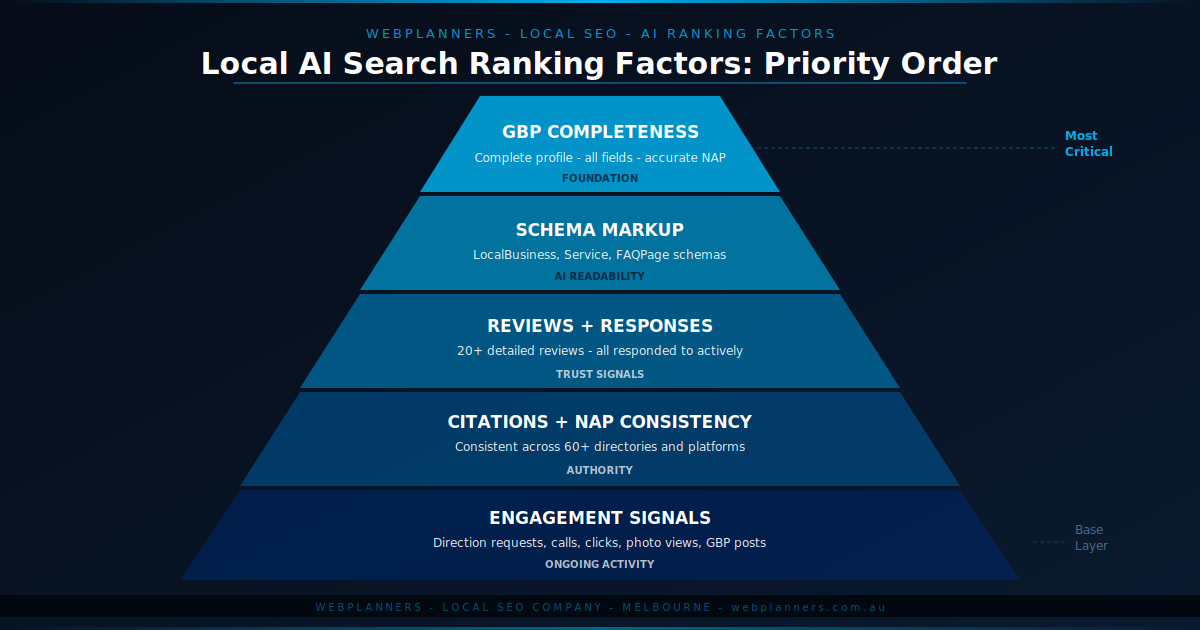
AI Google Maps ranking in 2026 draws on a broader set of signals than most local SEO guides cover.
1. Review Quality Over Quantity
A hundred five star reviews that say "great service" are worth less than twenty that describe what was done, where, and how the experience went. AI systems read review content now. The specifics matter.
Reviews mentioning particular services, locations, or outcomes carry considerably more weight than short generic ones. Ask customers directly after the job and tell them what to include. Respond to every review with something specific, not a copy paste template.
2. Consistency Across All Local Data Points
AI systems cross-reference your business data across multiple sources. Inconsistencies between your website, GBP, social profiles, and directory listings reduce how confidently AI platforms surface your business.
A full local citation audit is one of the most impactful early steps in any local SEO AI optimisation programme.
3. Engagement Signals
Google Maps tracks how users interact with your listing. Direction requests, phone calls, website clicks, and photo views all signal relevance to AI ranking systems.
An actively managed GBP with fresh content, regular posts, and photo updates outperforms static profiles in AI-influenced local rankings quite consistently.
AI Search Local Ranking Factors: A Practical Checklist
Working through this list is how businesses improve their Google Maps ranking using AI for local SEO:
- Complete GBP with all fields filled accurately and consistently.
- LocalBusiness and Service schema implemented and validated.
- NAP consistency verified across all directories and platforms.
- Minimum 20 recent, detailed reviews with active responses.
- Hyperlocal service pages published and internally linked.
- FAQ content structured with question-based headings and direct answers.
- Monthly GBP posts with service updates, offers, or case studies.
- Photo library updated quarterly with real business imagery.
- Location-specific blog content published regularly.
- Core Web Vitals within recommended thresholds on mobile.
Getting through this list properly is what expert local SEO services actually look like in practice.

How Does AI Assist Local SEO Strategy?
Beyond ranking in AI results, AI tools are changing how local SEO strategies get built and executed.
1. AI-Powered Competitor Gap Analysis
AI tools can go through what your top local competitors are doing across their GBP, website, and content far faster than manual analysis allows. That reveals the specific gaps to close to move ahead in local rankings.
2. Conversational Query Research
Local customers search using conversational, question-based queries more than they used to. AI research tools identify the exact phrasing your target audience uses so your content matches real local intent rather than assumed intent.
3. Review and Reputation Intelligence
AI tools can monitor your review landscape across multiple platforms, identify sentiment patterns, and flag urgent responses. This keeps your reputation data consistent and your response times fast, both of which matter for AI search local ranking.
The power of AI-driven SEO today is in how it accelerates every part of the strategy, from research to execution to monitoring.
Why Working with a Local SEO Company That Understands AI Matters
Many traditional local SEO agencies are still running the same playbook they used in 2020. Review generation campaigns, generic citation building, and keyword-stuffed GBP descriptions don't produce what they once did. The landscape moved and the tactics didn't.
As a trusted AEO company, we understand how both local search fundamentals and AI search can build a strategy that works across the traditional three-pack and the newer AI-generated local results. Mostly what separates agencies here is whether they understand the second part or just the first.
At Webplanners, our team covers the following:
- Technical local SEO including schema, GBP management, and citation audits.
- AI search optimisation including entity structuring and answer-first content.
- Hyperlocal content strategy that builds genuine authority in your service area.
- Ongoing performance monitoring across both traditional and AI search metrics.
This is what a 2026 local SEO strategy actually needs to cover. It is what we deliver for local businesses across Melbourne and Australia.

Final Thoughts
AI for local SEO is not a future consideration. It is a present requirement for any Australian business that wants to dominate Google Maps and local search in 2026.
The businesses that adapt their local SEO strategy for AI systems now will accumulate authority, visibility, and lead flow that compounds over time. Those that stick with outdated tactics will find themselves increasingly invisible in a search landscape that is moving quickly in one direction.
Webplanners is a trusted local SEO agency working with local businesses across Melbourne and Australia. We build AI-ready local SEO strategies that deliver real, measurable results. Get in touch with us today to know how we can help your business grow.
FAQs
What is AI for local SEO and how is it different from traditional local SEO?
Traditional local SEO was about ranking in the standard three-pack. Fill out the profile, collect reviews, build citations. AI local SEO is a different task. It involves structuring your local data, Google Business Profile, schema markup, and content so that AI systems like Gemini can interpret and recommend your business in location-based queries. The answers AI generates now appear above and alongside traditional results; so being invisible in them is a real commercial problem.
How does AI affect Google Maps ranking in 2026?
GBP completeness, review quality, local schema accuracy, NAP consistency, and engagement signals like calls, clicks, and direction requests all feed into it. Gemini's integration with Google's local index means these data points now influence AI-generated local recommendations rather than just populating a standard map result. Getting the data right across all of these is what moves the needle; however, most businesses are still only managing one or two of them properly.
What local SEO AI optimisation steps should I take first?
Start with the foundations. Ensure your GBP is complete and consistent, implement LocalBusiness schema across your website, audit your NAP data across all directories, and begin building hyperlocal content around your service areas. These are the steps a trusted local SEO agency like Webplanners prioritises first because they deliver the fastest improvement in AI search local ranking.
How important are Google reviews for AI local search visibility?
Very important and becoming more so. AI systems like Gemini analyse review content, not just review volume. Reviews that mention specific services, locations, staff, and outcomes contribute more to your local SEO AI optimisation than a large number of one-line generic reviews. Actively encouraging detailed reviews and responding to every one of them is now an AI SEO task, not just a reputation management task.
Can a local SEO company in Melbourne help with Gemini and AI search visibility?
Yes. A local SEO company in Melbourne that understands AI search can build a strategy that covers both traditional Google Maps optimisation and the newer AI-generated local results. This includes GBP management, local schema, hyperlocal content, citation audits, and ongoing monitoring of how your business appears across AI platforms. Webplanners deliver all of this as an integrated service.
How long does it take to improve AI local search rankings?
GBP and schema fixes can start showing results within four to six weeks. Building the content authority and citation consistency needed for sustained AI local search visibility is a longer process, quite often three to six months depending on the market and competition level. Webplanners track both traditional local rankings and AI citation patterns throughout; so you can see where progress is happening rather than waiting for a quarterly report to find out.